Buying camping gear through links on this page may earn Basecamp Budget Lab a small commission at no additional cost to you. How Basecamp Budget Lab earns revenue
Sleeping on a camping cot gets you off hard, uneven terrain, makes sitting down and standing up effortless, and opens up valuable storage space inside your tent. However, picking the right cot requires balancing frame dimensions against tent wall slopes, managing packed weight, and solving the airflow issue known as "cold cot syndrome."
Unlike sleeping on the ground—where soil slowly traps some conductive warmth—an elevated cot exposes your underside to circulating air. According to sleep system analysis from Camping for Beginners, moving ambient air beneath a bare fabric cot deck accelerates convective heat loss, often making an uninsulated cot uncomfortably cold once nighttime temperatures drop below roughly 60°F (15°C). Building a complete cot sleep setup often involves matching the cot's geometry to your tent and adding an insulated pad when conditions cool down.
Quick Selection Path
- For spacious family tents or taller campers: Choose a wide, extended-length model (such as an 80 cm wide deck) with high ground clearance for bench-style seating.
- For compact dome tents and low sloping walls: Opt for a low-profile cot (around 15–20 cm off the ground) so your face and sleeping bag do not rub against condensation on angled tent walls.
- For shoulder season and chilly nights: Always top your cot deck with an insulated sleeping pad featuring an established R-value to halt convective heat transfer.
What to Look for in a Camp Cot
Before purchasing an outdoor folding bed, check four physical parameters against your existing tent setup:
- Tent Wall Slope and Clearance: A cot stands 15 to 40 cm above the ground. In a dome or backpacking tent with steeply angled walls, elevating your sleeping surface pushes your head and feet closer to the rainfly, reducing usable length and increasing contact with wall condensation. Check your tent's interior floor dimensions and wall angle before choosing cot height.
- Deck Width and Shoulder Room: Standard camp cots measure roughly 60 to 65 cm across. Active side sleepers or broader individuals often find their shoulders or arms resting on the rigid perimeter side poles. Cots measuring 70 to 80 cm wide provide far more natural sleeping posture without frame contact.
- Frame Assembly Mechanism: Modern ultralight and compact cots rely on side rails tensioned by transverse shock-cord legs using spring-loaded lever locks. Verify whether the frame uses quick-clamp tension levers, which reduce the hand strength needed during assembly and breakdown.
- Tent Floor Point Loading: Cot legs concentrate body weight onto small rubber or plastic foot caps. In lightweight tents with thin silnylon or polyurethane bathtub floors, these pressure points can abrade or puncture the fabric. Placing small protective coasters, foam squares, or durable floor mats under each foot is recommended.
Wide-Deck Option for Taller Campers
When sleeping room is the highest priority and pack size is secondary, an oversized cot deck prevents limbs from resting against the metal perimeter rails.
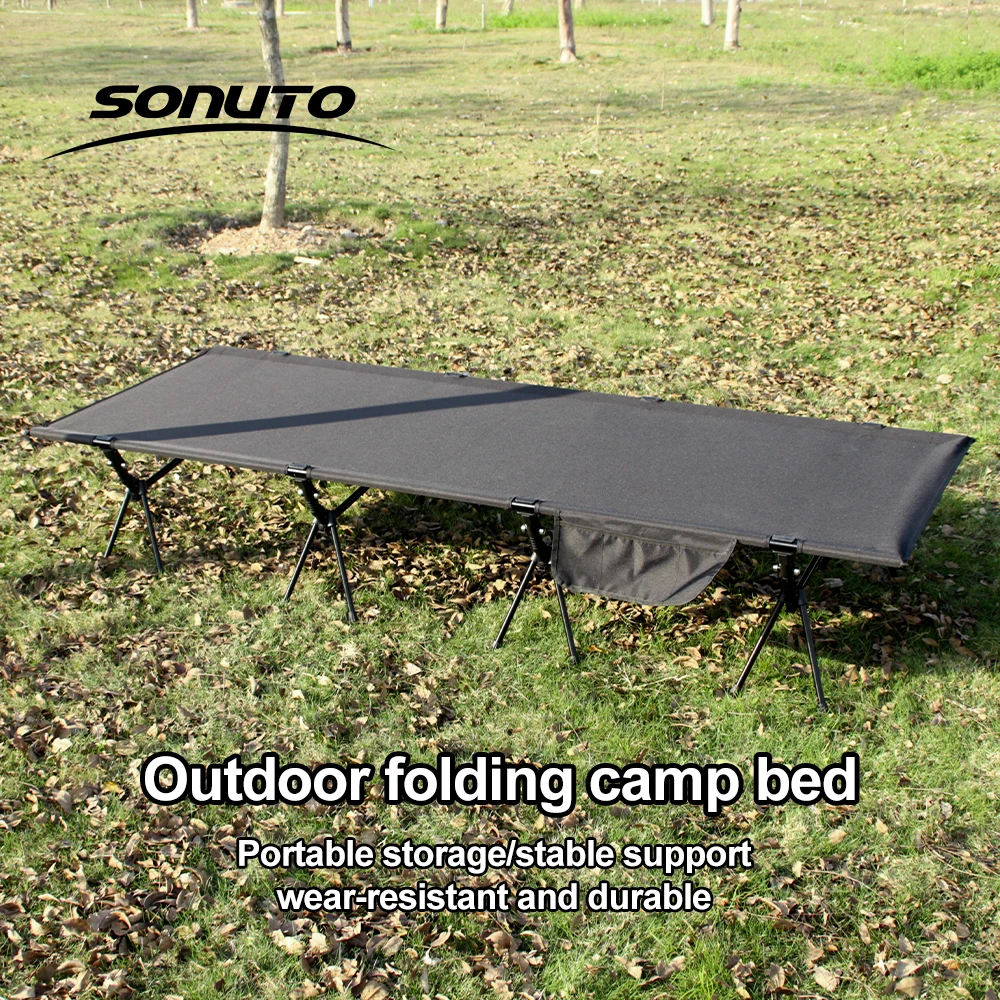
The Sonuto 210X80cm 600D Oxford Camping Cot is advertised with generous dimensions of 210 cm in length and 80 cm in width, paired with heavy-duty 600D Oxford fabric. The listing claims an overall weight of 4 kg (approximately 8.8 lbs). In the seller image, the frame features a multi-leg standing configuration with an integrated side storage pocket for small accessories.
- Who it suits: Taller campers and car campers using large cabin or tunnel tents where interior height allows a higher, longer frame.
- Trade-offs and verification: At an advertised 4 kg and substantial assembled footprint, it is unsuited for backpacking. Buyers should verify packed bag dimensions with the seller to ensure it fits comfortably in their vehicle trunk or cargo box, and check the manufacturer's exact static weight rating prior to purchase.
Convertible Lightweight Cots for Flexible Setups
Some contemporary folding cots feature dual-height leg designs, allowing campers to switch between a low-clearance frame for small tents and extended leg pegs for bench-height car camping.
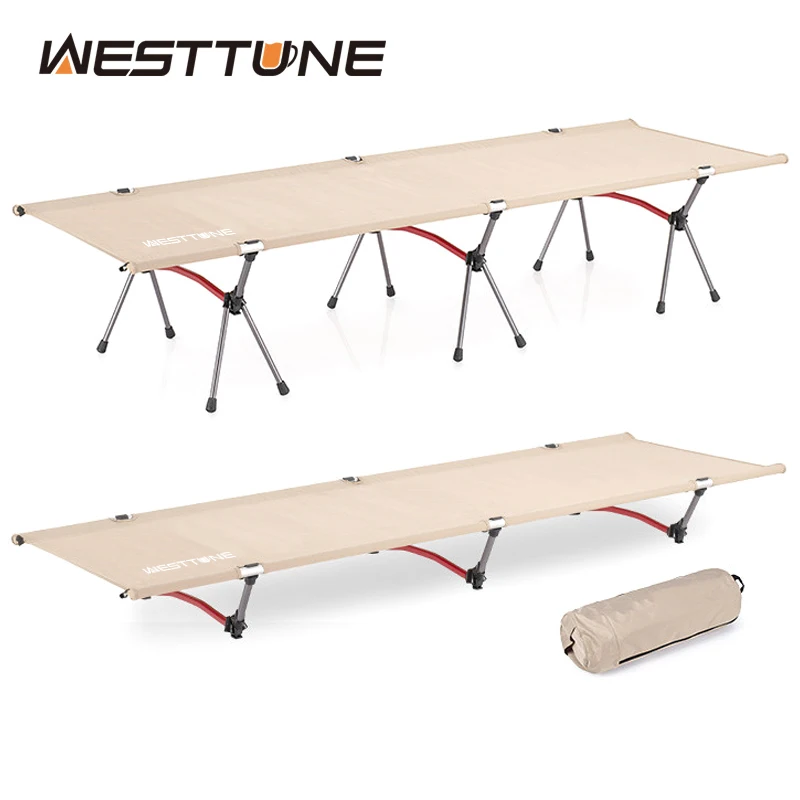
The WESTTUNE Ultralight Aluminum Alloy Camping Cot is listed as a portable folding sleeping cot designed for outdoor hiking, backpacking, and travel. Visual labels on the listing illustrate two setup configurations—a low-profile stance and an elevated stance using leg extensions—supported by curved cross-braces with tensioning lever clips.
- Who it suits: Campers who transition between smaller backpacking tents (where ceiling clearance is low) and larger shelter setups where bench-height seating is preferred.
- Trade-offs and verification: The base listing price is notably low ($16.59 reference price at capture), which in marketplace listings frequently corresponds to an accessory option (such as leg extensions, a sheet, or a spare mat) rather than the complete cot frame. Before ordering, confirm the exact selection tier to verify whether the package includes the full alloy frame, bed canvas, and leg extensions.
Low-Profile Cots for Compact Tent Cabins
If your shelter has aggressive wall slopes, a low-profile cot keeps you off cold, damp ground while maximizing headroom.
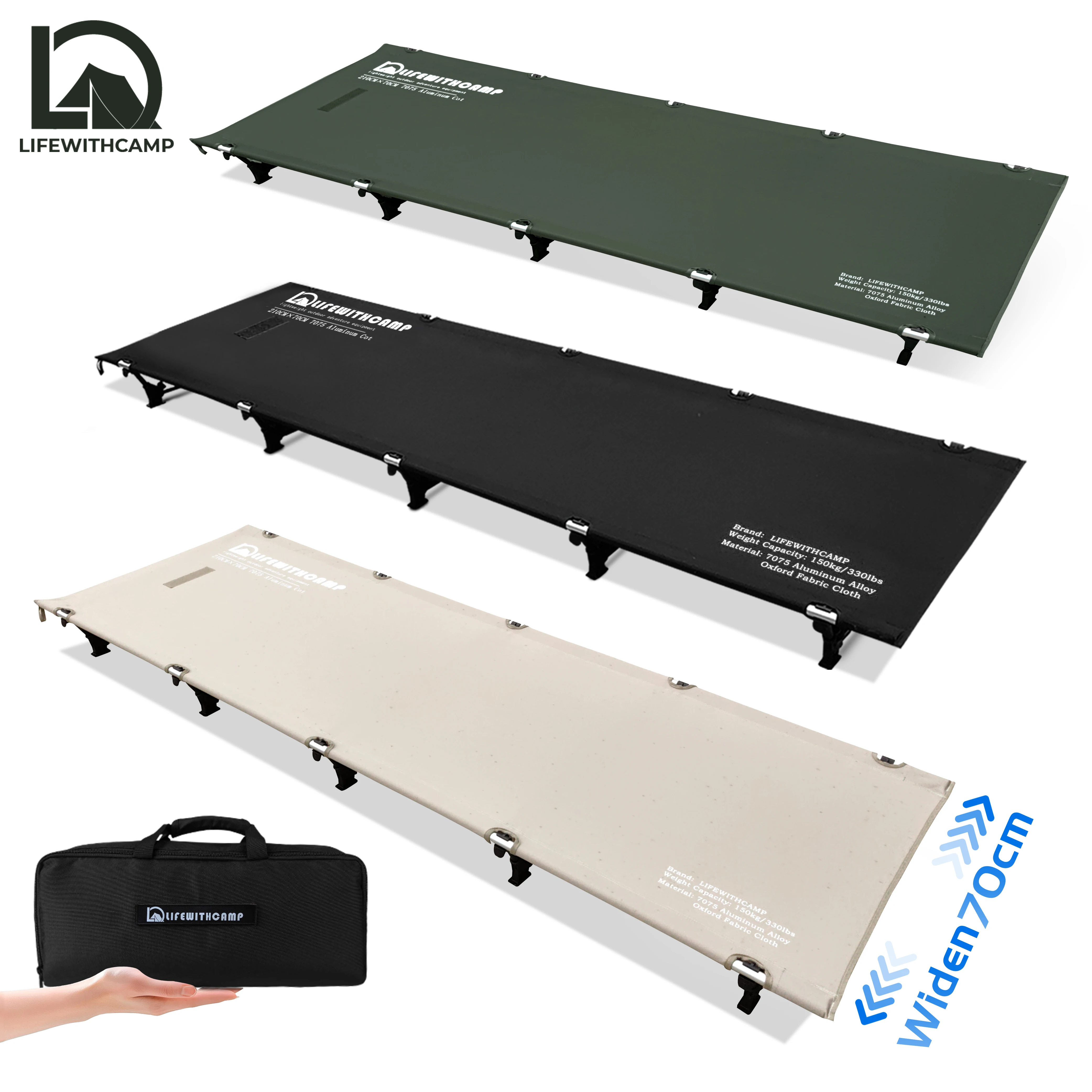
Sold via Stone's Store, the 70cm Wide Portable Folding Camping Cot displays clear product labeling in its listing imagery under the brand name LIFEWITHCAMP. The image markings state a 70 cm width, 7075 aluminum alloy construction, Oxford fabric cloth, and an advertised load capacity of 150 kg (330 lbs). The frame employs five low-slung, arch-style leg assemblies that sit close to the floor, packing down into an included zippered carry pouch.
- Who it suits: Solo campers and backpackers sleeping in two- or three-person dome tents where vertical clearance is limited.
- Trade-offs and verification: The 5-leg assembly requires engaging multiple tension levers along the side rails during setup. Check the included instruction card for proper lever orientation to prevent pinching fingers during assembly or accidental release under load.
The Missing Component: Insulating Your Cot
Even the sturdiest cot fabric provides virtually zero thermal resistance. Cold nighttime breezes circulate freely beneath the cot, pulling body heat away through the stretched fabric via convection. In cold weather, adding an insulated sleeping mattress on top of the cot deck creates a comfortable, thermally protected sleep system.
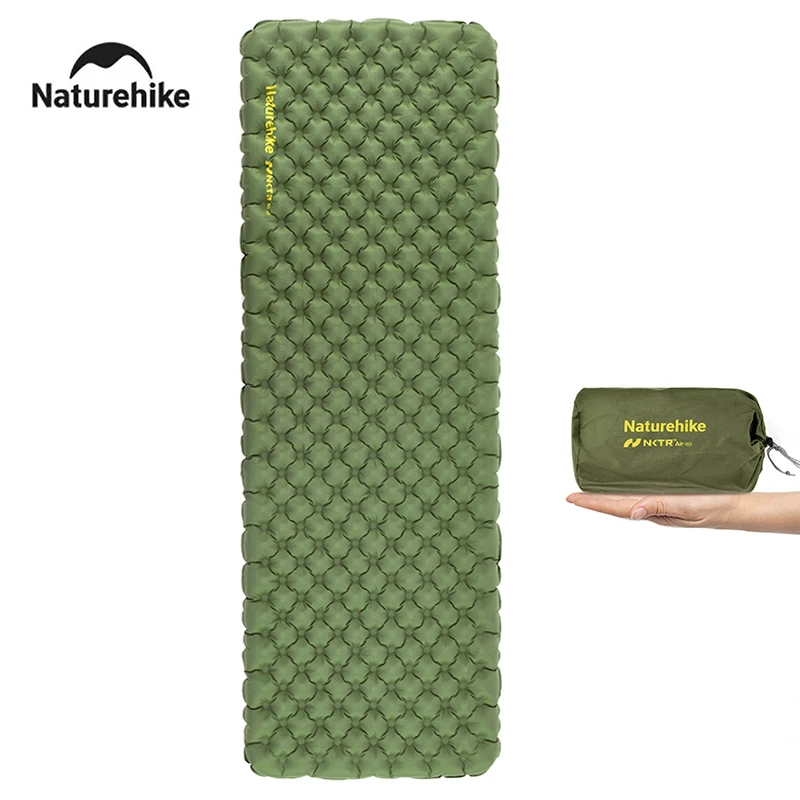
The Naturehike Ultralight Folding Air Sleeping Pad is an inflatable mattress advertised with an R-value of 4.6. This high thermal rating indicates an internal structure designed to suppress convective air movement and reflect radiant warmth back toward the sleeper.
- Why pair it with a cot: Placing a 4.6 R-value air pad directly on top of a 70 cm or 80 cm cot deck solves two problems at once: it provides deep air cushioning to eliminate contact with perimeter frame rails, and it stops bottom-side convective cooling completely, turning a warm-weather cot into a dependable shoulder-season and cool-weather sleep station.
- Fit check: Verify that the pad's inflated width does not significantly exceed the width of your cot frame, ensuring it sits flat between the side rails without buckling.
Cot Specifications and Selection Summary
| Option | Advertised Deck Width | Stated Material / Specs | Primary Purpose |
|---|---|---|---|
| Sonuto 210X80cm Cot | 80 cm (210 cm length) | 600D Oxford cloth, 4 kg claimed weight | Large tents, car camping, broad shoulders |
| WESTTUNE Ultralight Cot | Not verified in title | Aluminum alloy, convertible dual-height image | Compact packing, adaptable height setups |
| LIFEWITHCAMP (Stone's Store) | 70 cm | 7075 aluminum, 150 kg (330 lbs) image label | Low-profile dome tents, compact packing |
| Naturehike Air Mattress | Mattress topper | Stated 4.6 R-value, ultralight air construction | Thermal barrier against under-cot convection |
Assembly and Tent Care Guidelines
To keep your cot functioning smoothly and prevent damage to expensive shelter floors, adhere to the following best practices:
- Assemble Outside or on Clean Ground: Slide the long side poles through the fabric sleeves before bringing the cot into your tent. Inserting cross-brace tension levers inside a tight shelter risks tearing thin tent walls or screen mesh.
- Engage Lever Locks with Care: Most modern alloy cots use mechanical leverage to bow the cross-members into tension. Always seat the fixed hook completely onto the opposite rail before clamping down the locking lever. Never force a misaligned clamp, as this can crimp or bend 7075 aluminum tubing.
- Protect the Bathtub Floor: Even smooth plastic cot feet exert concentrated downward force when you sit down. Place furniture caster cups, cut squares of closed-cell foam, or an extra protective tarp under the legs inside the tent floor.
- Observe Stated Weight Capacities: Static weight ratings assume evenly distributed loads while lying down. Avoid standing on the cot deck or dropping heavily onto the center of the rails, which produces dynamic peak forces well above normal sleeping limits.